
Earl's Gold Deciduous Azalea
Rhododendron 'Earl's Gold'
- 4.5 in · $19.99
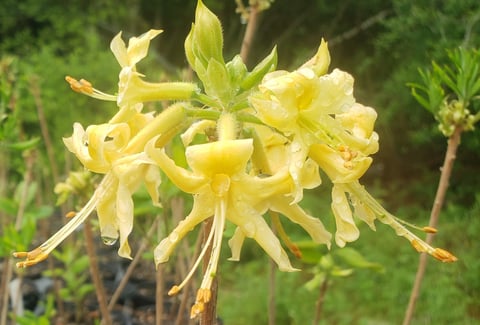
The large rounded clusters of deep orange and gold buds open to sunny yellow, fragrant flowers that attract butterflies, bees, and hummingbirds in early spring atop the bare stems. Earl's Gold Deciduous Azalea, an Earl Sommerville hybrid, develops into an upright to rounded, medium to large deciduous shrub well suited to bright woodland settings but will also thrive in full sun under good conditions. Like the Aromi hybrids, the Earl Sommerville hybrids show excellent tolerance to the heat and humidity of the Southeastern US. Sometimes still fondly referred to as Wild Honeysuckle Bushes, these nativars will do best in an average moist, well-drained, fertile, acidic soil from partial shade to full sun conditions. Topdress with an organic mulch like pinestraw, a.k.a. pine needles, or pine bark.
Azaleas need a humus rich, acid soil and adequate moisture during establishment as well a good organic mulch. The mulch will keep the root zone cooler and at a more stable temperature, helps to conserve moisture, controls competition from weeds, and as it breaks down it's nutrients are slowly released back into the soil feeding your plants. Properly mulched Azaleas often need little additional nutrients once they are well established. Never use lime around Azaleas and realize that many of your 'garden' fertilizers like 8-8-8 and 13-13-13 contain lime as a filler so this could be toxic to them. Use a slow release, non-burning acidifying fertilize instead when needed. See our growing guide for more detailed Azalea growing info.
For excellent and detailed information on growing deciduous Azaleas, including heat tolerant deciduous types, see "Selecting and Growing Azaleas" from the University of Georgia Extension Service. There is also an interesting article from the Washington Post by Adrian Higgs titled "Azaleas Other Than Pink" that describes the origin of the heat tolerant Aromi Deciduous Azalea hybrids and was published in the May 19, 2005 online edition and in print on June 2, 2005. This article also highlights the importance that David Ellis and Maarten van der Giessen have played in making sure that these beautiful, generally fragrant, and mostly vigorous deciduous azalea hybrids have not been lost but instead now have the potential to be shared with and enjoyed by gardeners across the U.S.
NOTE: We list the Aromi Deciduous Azaleas with the native plant category because of their resemblance in habit and form to many of our US native deciduous azalea species, though they are not in fact a true native species but are hybrids and these are often referred to as 'nativars'. Dr. Aromi used native species as well as hybrids in his breeding work to develop this heat tolerant series with the beauty, poise, colors, vigor, and fragrance of our native deciduous azalea species in hopes that they might be enjoyed throughout a much broader range of the US, but especially for the hot humid South like that of Mobile, Alabama, and they are known to do well in much of zones 6-9.
- Zones
- 5, 6, 7, 8, 9
- Sun
- Full sun, Mostly sunny, Part shade, Part sun, Filtered shade
- Size
- 6-8'H x 4-6'W
- Bloom
- Early spring.
- Soil
- Moist to average moist, well-drained acidic soils rich in organic matter top dressed with an organic mulch.
Family: Ericaceae
Find it in: Shrubs & Trees, Butterfly Plants, Cut Flowers, Fragrant Plants, Hummingbird Plants, Louisiana Native Plants, Native Plants, Plants by Flower Color, Shade Tolerant Plants, Shrubs by Size Class, Rare & Unusual Plants