
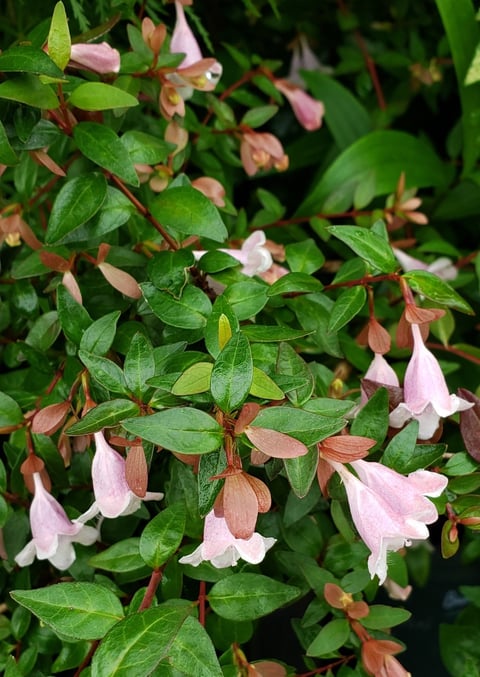
Edward Goucher Glossy Abelia
Abelia × grandiflora 'Edward Goucher'
- 4.5 in · $14.99
One of the earliest to begin flowering and an RHS Award of Garden Merit winner! Clusters of lilac-pink tubular flowers are produced in abundance beginning in midspring and continuing into fall and are held against a contrasting foil of long-lasting showy deep bronze-red bracts and exceptionally dark green glossy foliage that takes on purple and bronze tones in winter. The flowers of Abelias attract a variety of pollinators including bees, butterflies, and hummingbirds. Edward Goucher Glossy Abelia, considered to be a hybrid of Abelia x grandiflora x A. shumanii, has a naturally dense, rounded to vase-shaped habit on this medium-sized, evergreen to semi-evergreen shrub. Abelias are known for their toughness and adaptability to a variety of soil types provided they have average or better drainage. Deer resistant, somewhat salt tolerant, and mature, well-established plants are moderately drought resistant. Provide a full sun to part shade site with moderately fertile, average moist soil for optimum vigor and flowering. Long one of our personal favorites!
Abelias are some of the most rewarding and easiest to grow shrubs, remaining evergreen in zones 8-9 and becoming deciduous in the coldest portions of their range. They are easily kept as neatly trimmed hedges or can be allowed to grow into their naturally rounded arching and fountaining form. For a low maintenance planting select an Abelia that grows to the appropriate size for the space given them and periodically remove the oldest non-productive canes or stems every 2-3 years. Like Blueberries and Spiraea, Abelias are tightly suckering shrubs producing new canes that eventually supplant the oldest ones and so will benefit from a periodic renewal of this type. The oldest woody canes can be removed near ground level and you can remove 1/3 to 2/3 of the total plant mass leaving the youngest most vigorous canes to grow and flower.
Optimally Abelias prefer a well-draining, moderately fertile, average moist soil with a half a day or more of direct sunlight. These are drought resistant plants and generally require little additional water once well-established. Good deer, salt, and pest resistance make these plants invaluable assets in the garden and landscape. Abelias are tolerant of a wide range of soil conditions from clay to loam and easily tolerate the reflected heat of asphalt and concrete.
Abelia flowers are produced on new growth and well established plants can flower for much of the summer under average conditions. Their nectar rich blossoms are frequented by a variety of butterflies, hummingbirds, bees of all shapes and sizes, as well as other garden beneficials.
- Zones
- 6, 7, 8, 9
- Sun
- Full sun, Mostly sunny, Part shade, Part sun
- Size
- 3-5(-8)'H x 4-6'W
- Bloom
- Mid to late spring to early summer and into fall. Earlier flowering in warmer winter regions.
- Soil
- Average moist, average to well-drained, fertile soils. Tolerant of a wide variety of soil types.
Family: Caprifoliaceae
Find it in: Shrubs & Trees, Bee Plants, Butterfly Plants, Deer Resistant Plants, Great Plant Picks for the Pacific Northwest, Heirloom Plants, Hummingbird Plants, Plants by Flower Color, Plants by Foliage Color, RHS Award of Garden Merit® Plants, Salt Tolerant Plants, Shrubs by Size Class, Drought Resistant Plants