
Flax-Leaf Ankle-Aster
Ionactis linariifolia
- 3.5 in · $14.99
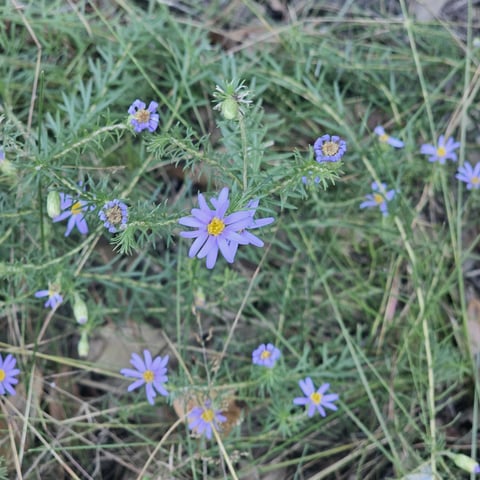
Up to 1" wide, light purple to blue, yellow-eyed daisies are borne in small clusters and singly atop a dense mound of bristly arching stems over an extended period in late summer and fall attracting a variety of smaller pollinators, especially bees. The Flax-Leaf Ankle-Aster, Ionactis linearifolia but potentially I. repens (see additional notes on this plant's full product page), is a clump forming, herbaceous, native perennial that grows from a woody base producing a multitude of small wiry stems that are adorned with very narrow, stiff, fine, gray-green foliage. The plants naturally form a fairly dense rounded and spreading mound of stems to about 12-18" high and 16-24" wide. Locally, we normally find this plant on deep, dryish, poor sandy or loamy soils. This unusual Aster is native to much of the central and eastern US. It is a tough, deer and drought resistant, native perennial that is suitable for the perennial garden, rock gardens, and xeriscaping as well as for naturalistic areas like meadows and roadsides. The plants are moderately shade tolerant, but may flower best where they receive 4-6 hours or more of direct sunlight. Provide the Flax-Leaf Ankle-Aster with a sharply draining sandy, loamy, or rocky soil and average moisture during initial establishment.
*Note: Guy Neesom, considered by many to be the North American Asteraceae specialist, has suggested that there is a species called Ionactis repens found in western Louisiana, Mississippi, Alabama, Georgia, and Florida. It is possible that these plants are that species as the main difference is that I. repens is rhizomatous where I. linariifolia typically is not, and the plants these seeds were collected from appeared to be rhizomatous as there was a colony of a dozen or more individual plants instead of single plants, which is what we have typically seen. The images are of the plants the seed were collected from. For more information, see Neesom's December, 2020 Phytoneuron article at: https://www.phytoneuron.net/2020Phytoneuron/91PhytoN-Ionactisrepens.pdf
Caterpillar host for Pearl Crescent and Silvery Crescent butterflies.
- Zones
- 4, 5, 6, 7, 8, 9
- Sun
- Full sun, Mostly sunny, Part shade, Part sun, Bright shade
- Size
- 12-18"H x 16-24"W
- Bloom
- Late summer and fall.
- Soil
- Well-draining, average moist to periodically dry, acidic, sandy or rocky soils. Moderate to high drought resistance once well-established.
Family: Asteraceae
Find it in: Groundcovers, 2026 New Plants, Bee Plants, Butterfly Plants, Deer Resistant Plants, Louisiana Native Plants, Native Plants, Perennials, Perennials by Size Class, Plants by Flower Color, Plants for Fall Color, Shade Tolerant Plants, Drought Resistant Plants, Rare & Unusual Plants