
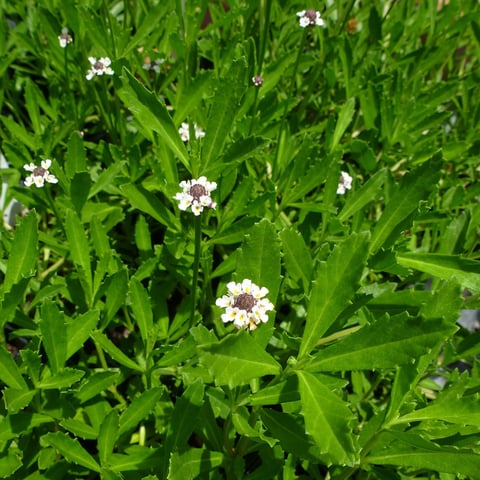
Frog Fruit
Phyla nodiflora
- 3.5 in · $6.99
The upright, drum-shaped flower heads are composed of tiny, nectar rich, white to light purple flowers that are produced from spring until frost attracting a variety of smaller pollinators. Frog Fruit-LA, a Louisiana selection of Phyla nodiflora, is a stoloniferous, mat-forming, evergreen to deciduous, native perennial groundcover adorned in deep green, narrow foliage. It seems to thrive in moist sites but is moderately tolerant to short-term drought once well-established. Frog Fruit has become one of the top recommendations for a lawn replacement due to its naturally low, dense growing habit reaching about 2-4" high and up to 6" high at flowering. A food source for the Common Buckeye, Phaon Crescent, and White Peacock butterfly caterpillars as well as a nectar source for a host of pollinators. Provide a moist to average moist site in sunny sites and plants are adaptable to soil types.
It is recommended that Frogfruit not be mown or cutback until after it has begun flowering in spring. An easy and sometimes vigorous groundcover or container plant that remains evergreen in mild winter climates but often goes winter dormant in areas that experience hard freezes, like zone 8. Frogfruit or Turkey Tangle Fogfruit is adaptable to soil types including clay, sand, as well as coastal plantings. Found naturally throughout much of the southern half of the US from east to west.
The USDA Plants database offers 11 synonyms for Phyla nodiflora but are generally variations of Lippia incisa, Lippia nodiflora, and Lippia reptans.
- Zones
- 7, 8, 9, 10, 11, (6?)
- Sun
- Full sun, Mostly sunny, Part shade, Part sun
- Size
- 3-6"H x 24-36"W, space at 12" apart
- Bloom
- Spring until frost to potentially year-round under warm winter condtions. Do not mow or clip until flowering has begun in spring.
- Soil
- Moist, wet, to average moist, poor to average fertile soils. Adaptable to soil types like clay to loam. Resistant to periodic flooding as well as short-term periodic drought once well-established.
Family: Verbenaceae
Find it in: Groundcovers, Bee Plants, Butterfly Plants, Heirloom Plants, Louisiana Native Plants, Native Plants, Perennials, Perennials by Size Class, Plants by Flower Color, Plants for Bogs & Wet Areas, Salt Tolerant Plants