
Mamou Bean
Erythrina herbacea
- 4.5 in · $17.99 · 6 available
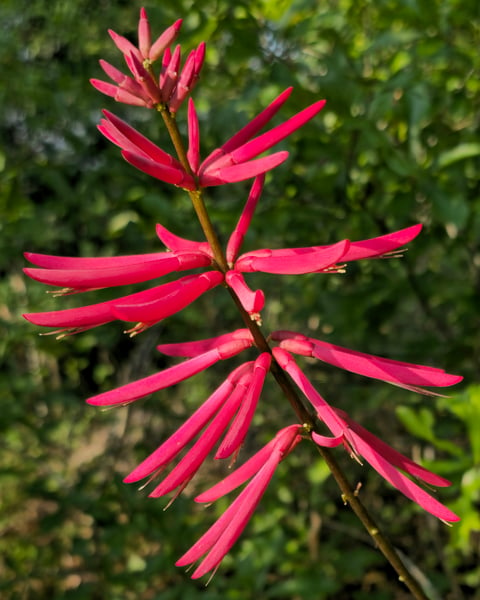
The sturdy, 3–5' flower spikes are adorned with bright red to purplish-red, 2–3" long, tubular flowers in mid-to-late spring and early summer, attracting mainly hummingbirds and Sulphur butterflies. The flowers are followed by dark brown to black, 6–8" long, necklace-like bean pods that split open at maturity to show off the starkly contrasting, bright red, toxic seeds that can persist well into winter. The Mamou Bean or Coral Bean, Erythrina herbacea, is a tough and easy, herbaceous, multi-stemmed native perennial that grows from a swollen, woody underground caudex in zones 7B–9, but may become more shrub-like in zones 10–11. The dark green, compound leaves often have prickles along the bottom of the main vein and occasionally along the flowering stems. It is adaptable to both the drier sandy loams of Louisiana's uplands and the heavier clay soils of the Coastal Plains, like the Cajun Prairie. The Coral Bean is native from the Gulf Coast into southern Arkansas, and up the Eastern Seaboard into the Carolinas. Provide a full sun to partly shaded site in average, moist, fertile soils with average or better drainage.
In areas that experience hard freezes, like zones 7B-9, young first year plants of the Mamou will likely benefit from a breathable, winter mulch - like pine needles or pinestraw, applied over the crown. In tropical climates, like zones 10-11, the Coral Bean can develop into a large shrub to small tree potentially reaching 8-20'H and equally wide.
Locally we see the Mamou all across the Pineywoods, but it seems to be most common in the drier, often loamy sandy uplands where its naturally underground main stem provides both fire tolerance and drought resistance making the plants more competitive in this biome, as well as providing exceptional winter hardiness in what is typically a very tropical Erythrina genus. While the plants are tolerant of partly shaded sites, they much prefer full sun to mostly sunny sites to maximize flowering and vigor.
"Tough" is really an understatement when it comes to the Mamou or Cherokee Bean as a very sweet East Texas Master Gardener once related to us during a presentation on native perennials. She stated that when they first had their driveway paved, the husband accidently let what was her grandmother's original planting get paved over. She said that it wasn't long before that plant pushed right up through those few inches of asphalt. So then husband decided he would just move it to a better location and proceeded to dig it up. After calling in the help of at least one friend they finally managed to get it out of the ground over the course of a weekend of solid digging and it would barely fit in the bed of a pickup.
For obvious reasons we cannot recommend the use of the this plant as an herb or decoration, but the Native Americans used the roots and seeds to treat a variety of ailments, and extracts have been used to make cough syrups, especially in southern Louisiana. Native Americans utilized the seeds as colorful beads, as did later early Louisiana settlers, who also used them to make rosaries. The seeds have also been known to have been used as effective rat and gopher baits.
- Zones
- 7B, 8, 9, 10, 11
- Sun
- Full sun, Mostly sunny, Part shade
- Size
- 3-5'H x 2-3'W (8-20' in zone 10)
- Bloom
- Mid-late spring and into summer.
- Soil
- Tolerant of most soil types but seems to grow and flower best under average moisture and moderate fertility. Drought resistant once well-established.
Family: Fabaceae
Find it in: Perennials, Butterfly Plants, Hummingbird Plants, Louisiana Native Plants, Native Plants, Perennials by Size Class, Plants by Flower Color, Plants by Fruit Color, Shrubs by Size Class, Songbird Plants, Drought Resistant Plants